The Balancing Act: AI Agents vs. Human Agents in the Modern Service Landscape
As artificial intelligence accelerates across industries, organizations face a critical choice that is rarely binary: how to balance the rise of autonomous AI agents with the irreplaceable value of human capital.


The Balancing Act: AI Agents vs. Human Agents in the Modern Service Landscape
As artificial intelligence accelerates across industries, organizations face a critical choice that is rarely binary: how to balance the rise of autonomous AI agents with the irreplaceable value of human capital. We are witnessing a shift where systems capable of performing tasks and making decisions with minimal supervision are entering the workforce. However, rather than acting as direct substitutes, AI and human agents offer distinct strengths and limitations. Understanding these differences is essential for designing resilient operations that navigate the trade-offs between efficiency and empathy.
The AI Agent: The Efficiency Engine
Powered by natural language processing (NLP) and machine learning, AI agents have become the workhorses of the modern era. Their primary contribution lies in their ability to handle the "heavy lifting" of data and routine interactions.
Advantages: Speed, Scale, and Data Intelligence
- Infinite Scalability and Availability: AI agents do not sleep, get sick, or experience fatigue. They offer true 24/7 availability, providing support at 3:00 AM just as effectively as at 3:00 PM. This scalability allows businesses to handle massive traffic spikes—such as during Black Friday sales—processing 10,000 concurrent interactions as easily as 10, without the need for emergency hiring.
- Cost Efficiency: While the initial development and deployment of AI systems require investment, the long-term cost per interaction is negligible compared to human labor. AI reduces overhead for routine queries and scales at a fraction of the cost of hiring, training, and managing large teams.
- Consistent Performance: AI delivers uniformity. It does not experience mood shifts or burnout, ensuring that every interaction adheres to strict procedural quality. This is particularly valuable in regulated industries where compliance is non-negotiable.
- Instant Data Processing: AI can reduce "hold time" to zero by instantly retrieving account details, order histories, and technical specifications. Beyond simple retrieval, they possess data-driven intelligence, capable of analyzing real-time trends and detecting patterns invisible to humans to optimize decision-making.
Disadvantages: The Contextual Gap
- Lack of Empathy and Nuance: The most significant limitation of AI is its inability to genuinely care. While it can mimic polite language, it suffers from "contextual blindness"—failing to detect sarcasm, "read between the lines," or comfort a distressed customer. In sensitive scenarios, such as bereavement-related account closures, AI often fails to provide the necessary emotional support.
- Rigidity and Edge Cases: AI struggles with creative problem-solving. It follows logic, which means it often misjudges ambiguous contexts or "edge cases" that require improvisation.
- Data Dependency and Risk: AI systems are only as good as their training data. Poor data can lead to biased outcomes, while Generative AI poses the specific risk of "hallucinations"—confidently stating incorrect information if not strictly guardrailed. Furthermore, the delegation of tasks to autonomous systems raises complex questions regarding transparency, privacy, and accountability.
The Human Agent: The Empathy Expert
While AI handles the quantitative side of operations, human agents remain the masters of the qualitative experience. They are essential for relationship building, complex negotiation, and judgment-based decisions.
Advantages: EQ and Critical Thinking
- Emotional Intelligence (EQ): Humans excel at interpreting tone, intent, and social cues. They can de-escalate anger, show genuine compassion, and build rapport, which drives long-term brand loyalty and trust—factors that are often the primary differentiator in high-stakes environments.
- Adaptive Problem Solving: When a problem falls outside the "script" or involves a "grey area," humans can draw on diverse life experiences to improvise. They can navigate novel situations that would stump an algorithm.
- Accountability and Judgment: Humans are capable of making ethical calls and judgment-based exceptions. For example, a human agent might decide to waive a fee for a loyal customer to preserve the relationship, a nuanced decision that rigid logic might strictly deny.
Disadvantages: Biological and Operational Limits
- Scalability and Consistency Issues: Human attention is finite. Agents can only handle one conversation at a time, and their performance is influenced by stress, fatigue, and emotional states ("off days"). This leads to variable service quality, where two agents might give different answers to the same question based on their individual training or memory.
- High Operational Costs: Employing human teams involves significant overhead, including salaries, benefits, training, and equipment.
- Slower Data Processing: Humans are naturally slower at processing data-heavy tasks and are more prone to errors when performing repetitive work, as attention naturally declines over time.
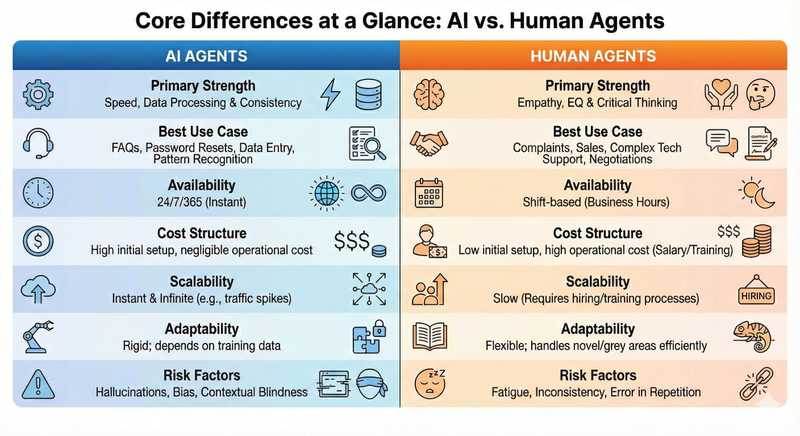
Core Differences at a Glance
The following graphic summarizes the key distinctions between the two, highlighting their operational roles.
Conclusion: The Hybrid Future
The comparison between AI and human agents reveals that they are not competitors, but complementary forces. AI is unmatched in efficiency, consistency, and scalability, while humans remain essential for strategy, innovation, and connection.
The verdict for a successful operation is a "Human-in-the-Loop" model. In this hybrid approach, AI acts as the first line of defense, handling the roughly 80% of volumes consisting of repetitive, simple tasks. This filters out the noise, allowing high-value human agents to focus their energy on the 20% of interactions that require genuine empathy, negotiation, and complex critical thinking. By leveraging AI for automation and humans for judgment, organizations can build systems that are both highly efficient and deeply human.
Ready to Build Your Next Project?
Let's discuss how we can help you build and scale your startup 4x faster with our proven development methodology.