Case study
Casa Paleologu: a custom course-sales platform, run for years without an IT department
A Bucharest cultural institution runs its entire commercial operation on a custom platform: enrollment, card payments, Romanian fiscal invoices, and customer accounts. A fraction of a developer operates the platform, in production since 2022.
- Client
- Casa Paleologu (paleologu.com), a Bucharest-based educational nonprofit with humanities courses for adults, children, and companies, summer schools, and its own publishing house
- Industry
- Education, culture, publishing
- Scope
- Custom course-enrollment and e-commerce platform - content management, online payments, automated invoices, customer accounts - built, operated, and extended continuously
- Engagement type
- Long-term product partnership, fractional capacity
- Team and timeline
- A fractional team, with additional help for the frontend relaunch


The challenge
Casa Paleologu is not a typical e-commerce client. It is a cultural institution that teaches humanities to adults, children, and companies. The programme includes a Cicero seminar, a rhetoric workshop for teenagers, summer schools, and study trips to Barcelona and Nuremberg. The institution also owns a publishing house.
It sells a product that off-the-shelf shop software does not fit: a seat in a live course. A course runs in sessions. Each session has a start date, a venue, a lecturer, a meeting schedule, and a limited number of places. Prices vary by audience and by date: early-bird windows, special rates, and corporate enrollments with an invoice to a legal entity instead of a person.
Next to the courses sit a scholarship program, a media archive, and a constant series of marketing campaigns. These campaigns address very different audiences: parents, young people, professionals, and HR departments.
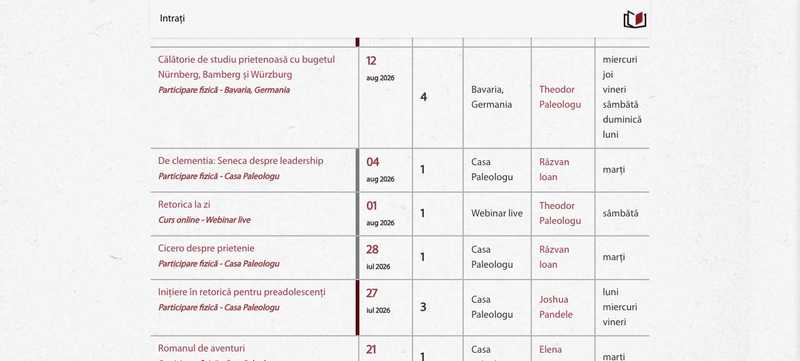
A standard webshop plugin cannot model any of that cleanly. A custom platform from an agency normally carries an agency-sized price, both to build it and to keep it in service. The second cost matters more. Casa Paleologu is a nonprofit, not a tech company. It has no internal IT department, and it does not want one. It needed custom software with the operating cost of a subscription.
What we built
The platform has two halves. Casa Paleologu owns both of them completely.
A headless backend on Directus. Directus is an open-source data platform. It gives the staff an admin interface for every operational record: courses, sessions, participants, books, orders, and scholarship applications. Six custom extensions on top of it encode the business itself:
- Course catalog and enrollment APIs, with segment-filtered views for each marketing audience
- Online card payments through Netopia (mobilPay), Romania's market leader for card payments, with the full encrypted confirmation handshake
- Automatic invoices through SmartBill: a proforma on order and a fiscal invoice on payment. This includes an invoice to a legal entity with company registration data, and no manual step for bookkeeping
- Participant lists and attendance sheets for every session
- Transactional email for the entire lifecycle: enrollment confirmations, payment receipts, password resets, and scholarship decisions
- Error reports through Sentry, and newsletter integration through Mailchimp
A modern storefront on Nuxt 3 and Vue. The server renders it for SEO, across roughly 60 pages:
- the course catalog with a category page per audience
- a multi-step checkout
- the publishing house bookshop with its own checkout
- a customer account area with active courses, past courses, invoices, feedback, and scholarship applications
- media and podcast sections
- a series of campaign landing pages, direct from the designer's Figma files
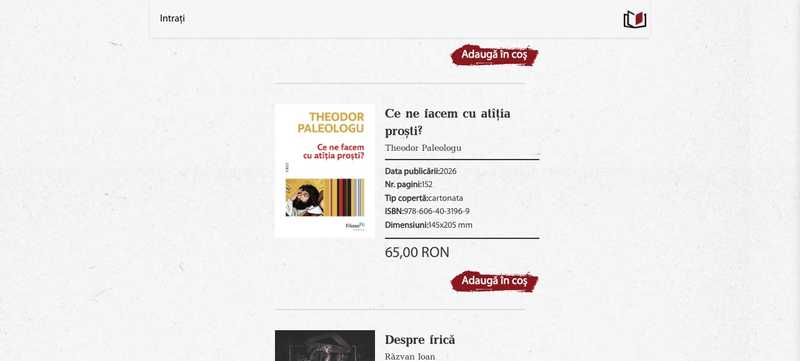
Today the entire chain runs without a person. The platform reserves the seat, charges the card, issues the fiscal invoice, sends the confirmation email, and adds the name to the participant list. Staff time goes into the courses and the curation, not into administration.
Affordable to keep, not only to build
The unusual part of this engagement is not a single feature. It is the cost profile. The platform went into production in 2022 and still runs today. A fraction of a developer operates it, extends it, and reworked it substantially two times. Three decisions make that possible.
A deliberately boring tech stack. Directus provides the admin UI, the permissions, and the data API out of the box. Custom code therefore exists only where the business is genuinely custom: payments, invoices, and enrollment rules. There is less software to maintain.
Custom code, small and replaceable. The six backend extensions and the frontend together form a codebase that one person can understand completely: about 21,000 lines on the frontend. The backend extensions encode business rules, not infrastructure.
Agentic development for the later phases. We built the 2024-2026 frontend relaunch AI-natively. Agent instruction files sit in every major directory of the repository, and AI agents did most of the work under review. A campaign landing page went from a Figma file to a deployed page in days, each one within a single day of commits. A full overhaul of the account area covered the dashboard, invoices, feedback, and scholarships, across the frontend and the backend. It shipped in short, focused steps instead of a project phase. This is how a fractional team delivers at a pace the marketing team can use.
The same approach now extends beyond the codebase. Management reporting runs on a live dashboard that reads the platform's own operational data. It shows five years of course sales per course, with a year-over-year comparison. An AI agent built it directly against the platform API, in one afternoon, instead of as a reporting project.
The relaunch
In late 2024 the original storefront from 2022 needed a replacement. The organization wanted faster pages, better search visibility, correct analytics, and a design refresh from new brand work.
We did not run a rewrite project with a budget to match. We built the new storefront next to the live one and switched it over page by page. The new storefront uses Nuxt 3 with TypeScript and server-side rendering. It tracks the entire funnel from a course view to a purchase in Google Analytics 4, and campaigns with the Meta pixel. It also adds automated sitemaps and the landing pages per audience that the marketing team never had before.
The backend ran without a change through the whole relaunch: the same Directus instance, the same extensions for payments and invoices, and four years of operational data intact.
Why a long-term fractional partnership works
A small organization usually gets two bad options. The first option is generic SaaS that does not fit the business. The second option is custom software that the organization cannot afford to maintain after the agency leaves. This engagement shows a third option: custom software designed from the first day for a fractional team to operate, on a boring tech stack. Agentic development multiplies what that fraction of a person delivers. The result behaves like an internal platform team, at a cost a nonprofit can carry each year.
The outcome
What the client walked away with
A nonprofit with no IT staff owns a custom platform for its entire commercial operation: course sales, book sales, payments, invoices, customer accounts, and scholarships. The platform ran for more than four years and survived a full frontend replacement with no interruption to operations
The chain from enrollment to invoice runs fully automatically, and includes Romanian fiscal invoices for individuals and for companies. The platform reserves the seat, charges the card, and issues the invoice. It then sends the confirmation and adds the name to the participant list
The marketing team gets custom landing pages and funnel analytics on demand, within days. Management sees five years of sales trends in a live dashboard that reads the platform's own data
Want custom software your organization can afford to keep?
We design custom software from the first day for a fractional team to operate. The result behaves like an internal platform team, at a cost a small organization can carry each year. Contact us and we will discuss what that means for you.