Case study
From scattered Excel files to an AI roadmap
A workshop-first engagement gave a European factory network a grounded answer to one question: where does AI pay off? The engagement delivered a prioritized shortlist of use cases, a roadmap ready for stakeholder approval, and one proof of concept specified for immediate implementation.
- Client
- Global industrial manufacturer (anonymized)
- Industry
- Industrial manufacturing and field service
- Scope
- Offer, order and project management processes across a multi-country European factory network
- Engagement type
- AI opportunity discovery and a roadmap for prototypes


The challenge
Our client is a global industrial manufacturer. It operates a network of factories and service locations across several European countries. Like most established industrial operations, its commercial core runs on processes that grew over decades. Staff calculate offers, process orders, and manage projects with a mix of ERP systems, document management tools, and above all Excel.
The leadership team knew that AI could make these processes faster and more consistent. They lacked a grounded answer to the questions that come before any tool:
- Where does AI pay off?
- Which processes need a standard first?
- Which use case deserves immediate implementation?
Our approach: workshops before prototypes
The TransFactor engagement model is deliberately workshop-first. We did not start with the technology. We started with the people who run the processes. With process owners from the client's locations, we mapped the flow from offer to order to project. We collected the real working documents behind that flow. We then scored the AI opportunities by impact and feasibility.
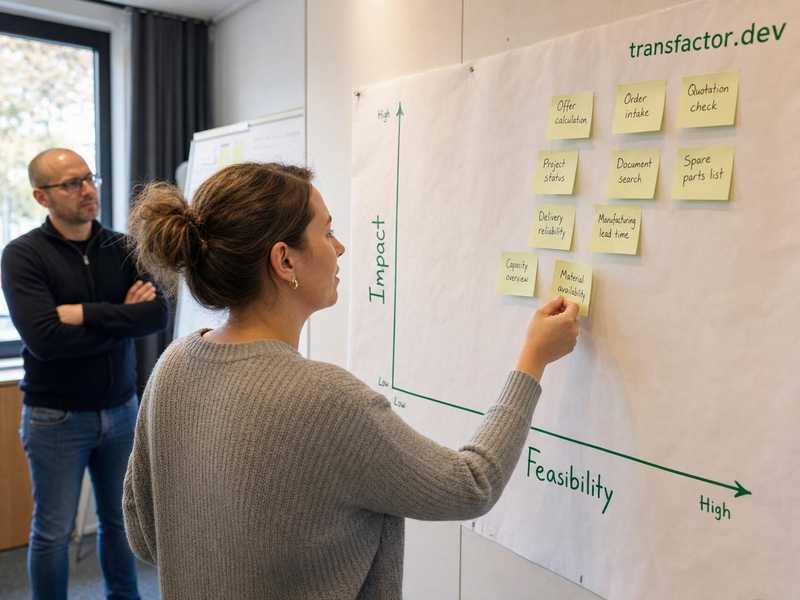
The engagement ran in five steps:
- Discovery workshops with process owners across the factory network
- AI-assisted analysis of the actual working documents and tools behind each process
- Prioritization of high-impact AI opportunities, each one with a return-on-investment assessment
- An AI and digitalization roadmap, prepared for stakeholder approval, with recommendations for process standards
- One proof of concept specified in full detail, ready for immediate implementation
What the AI-assisted analysis found
One example shows why the analysis at document level matters. A single calculation workbook in the quotation process existed in several parallel variants, one per process stage. Each variant contained more than twenty linked worksheets, with cascading formula chains and shared lookup tables. Staff maintained them by hand, and the change histories of the variants drifted apart.
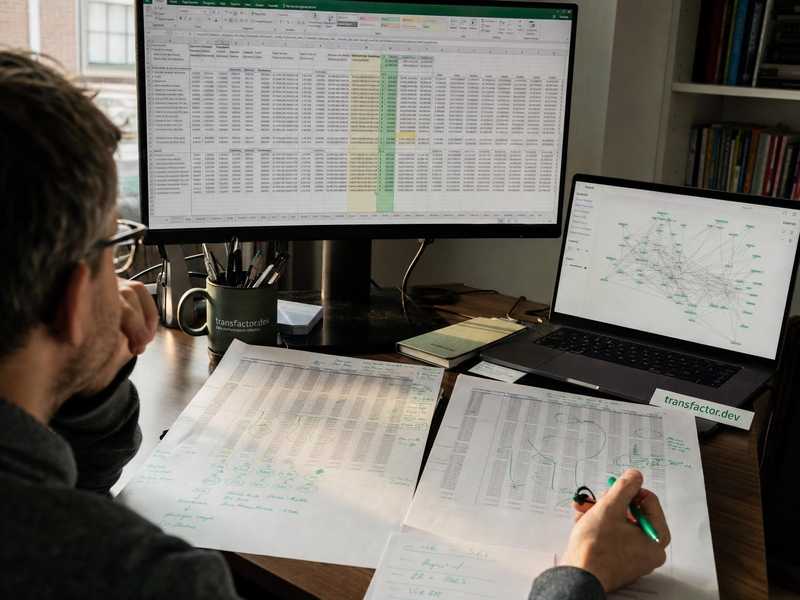
With AI tooling we mapped the full structure, the formula dependencies, and the exact differences between the variants. That work took hours. A manual review would take weeks. Findings like these had two effects. They gave the standardization recommendations a concrete, evidence-based basis. They also showed the client's team, on their own documents, what an AI-assisted process analysis does.
Why workshop-first works
AI initiatives in industrial operations fail most often for non-technical reasons. The use case does not match the real work, or the future users had no part in the choice of the tool. Two measures remove both failure modes before the first prototype. Run the discovery as workshops with the process owners. Validate each opportunity against real working documents, not against an idealized process diagram.
The outcome
What the client walked away with
A prioritized shortlist of AI use cases, each one with a return-on-investment assessment. The client's own process owners selected them, not an outside party
An AI and digitalization roadmap ready for stakeholder approval. It recommends a standard process across the locations before any automation
One proof of concept, specified in enough detail for an immediate start of the implementation
Do you work on similar questions?
If your factory or service network runs on processes like these, a workshop is the cheapest method to find where AI pays off. Contact us and we will set one up.